Can Security+ and Network+ Help You Get Noticed in IT Without a Four-Year Degree
- admin

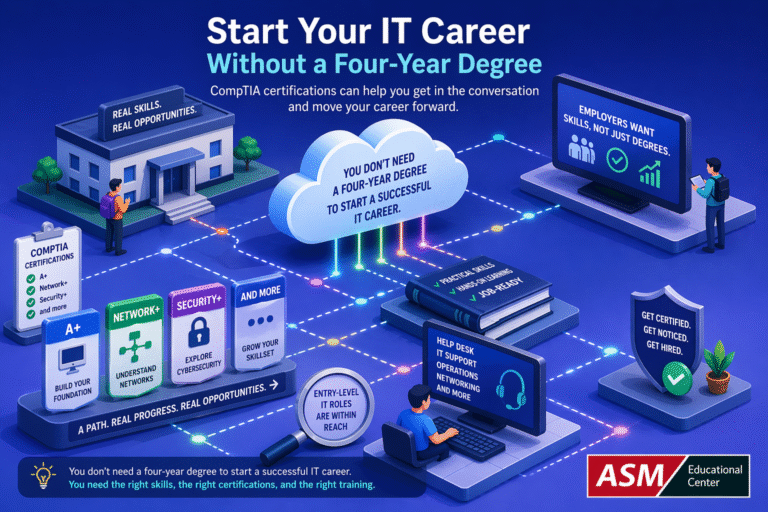
Can Security+ and Network+ Help You Get Noticed in IT Without a Four-Year Degree?
A lot of people still assume the only serious way into IT is a four-year degree. That is no longer the full picture. At ASM Educational Center, we do not believe a college degree is a bad thing, and we are not arguing that higher education has no value. A degree can still be a strong asset, and in some areas of IT and cybersecurity it remains the more traditional route. What we are addressing is the stigma that you must have a four-year degree to break into tech at all. That idea is much harder to defend in today’s job market. NACE reports that 70% of employers in its Job Outlook 2026 survey use skills-based hiring, and BLS data for computer user support specialists shows that many jobs in that area do not require a bachelor’s degree. In 2025, BLS found that 43.6% of those jobs required a high school diploma and 32.9% required an associate’s degree.
That does not mean degrees stopped mattering. It means they are not the only credible way to begin. BLS says candidates for computer support specialist roles may qualify with a high school diploma plus relevant IT certifications, while also noting that some more advanced roles, such as information security analyst, still typically call for a bachelor’s degree and related experience. That is the balance worth keeping, and it is the same balance ASM tries to communicate to students every day. College is valuable, but it is not the only legitimate starting point for a real IT career.
That is one reason CompTIA certifications continue to matter. Certifications like A+, Network+, and Security+ give employers something concrete to evaluate. They are widely recognized, tied to practical job skills, and often align well with the kinds of entry-level IT roles people pursue first. For many beginners, they offer a clearer and more practical starting point than assuming a traditional academic route is the only path forward. At ASM Educational Center, that is exactly how we look at them: not as magic shortcuts, but as structured, employer-recognized steps that can help students build real momentum.
Can you start an IT career without a degree?
Yes, in many cases you can. Entry-level IT roles often focus on practical ability, troubleshooting, communication, and the willingness to learn. Support, desktop, operations, and junior infrastructure positions are often where people get their first break, especially when they can show recognized certification and real effort behind it. BLS explicitly notes that computer user support specialist jobs do not necessarily require a college degree and that candidates for computer support roles may qualify with a high school diploma plus relevant certifications.
That said, it is important to be honest about what certifications do and do not do. They can help open the door, but they do not replace experience in every situation, and they do not override every employer’s hiring standard. Some roles still prefer or require a degree, especially later in a career or in more specialized tracks. At ASM, we think the stronger message is the more credible one: certifications can help you get started faster, but they work best when they are paired with preparation, hands-on practice, and the ability to explain what you know.
Can CompTIA certifications replace a degree?
For many early-career IT roles, they can absolutely help you get into the conversation. That is especially true for jobs focused on troubleshooting, support, networking basics, device management, operating systems, and customer-facing technical work. Employers hiring for those roles often care deeply about whether you can solve problems and communicate clearly.
The better way to frame it is this: CompTIA certifications can help you compete for many entry-level roles without a four-year degree, but they do not replace experience, and they do not guarantee a job on their own. What they do is give you a credible foundation and a recognized starting point. That is why ASM Educational Center focuses so much on helping students choose the right first certification instead of chasing credentials out of order.
The best CompTIA certification path for beginners
For most beginners, the strongest path is still A+, then Network+, then Security+. That order makes sense because it follows how technical knowledge usually builds in the real world. It also matches the way many students at ASM Educational Center build their confidence. Starting with the fundamentals first usually makes everything that comes after easier to understand.
A+ is still the best place to begin for most people who are starting from zero. It helps build your foundation in hardware, operating systems, troubleshooting, networking basics, and support skills. If someone is new to IT, A+ usually gives them the best first structure.
Network+ is often the next step once that base is in place. It helps move learners beyond general support and into networking and infrastructure concepts. That matters because many people discover that networking knowledge makes everything else in IT easier to understand.
Security+ usually makes the most sense after that. It is a strong certification, but it becomes much more valuable when it rests on real understanding of systems, networks, and technical fundamentals. For many students, Security+ is not the best first certification. It is the stronger third step.
At ASM, this sequence matters because students often do best when they build in the right order. A strong base usually leads to better retention, better confidence, and a better chance of actually using the material in a real-world role.
What do the exams really cost?
Certification is usually far more affordable than a four-year degree, but it still needs to be taken seriously. Exam vouchers, study time, training, labs, and possible retakes all add up. That is exactly why students benefit from being deliberate before they book an exam.
This is where a structured training path matters. Instead of piecing everything together on your own and risking expensive missteps, many students do better when they follow a guided plan with instruction, support, and a clear sequence. That kind of structure can save time, reduce confusion, and help students prepare with more confidence.
At ASM Educational Center, students can speak directly with the team about which certification path makes the most sense for their background, goals, and budget. That is often a much better starting point than guessing which exam to take first or trying to build a study plan in isolation.
How long does it take to prepare?
There is no honest universal timeline because people start from very different places. Someone with technical exposure, workplace experience, or personal lab practice will move differently than someone who is completely new to IT.
What matters more than rushing is building real competence. A+ can help establish the base. Network+ can deepen technical range. Security+ becomes more valuable when it is built on understanding instead of memorization. The goal should not be to collect exam names as fast as possible. The goal should be to become employable and confident.
That is why structured preparation matters. At ASM Educational Center, we see that students usually do better when they have a clear path, realistic expectations, and guidance on what to focus on next.
What kinds of jobs are realistic?
It is always better to talk about job families than to promise that one certification leads to one salary or one exact job title. For most beginners, the more realistic first targets are support, help desk, desktop support, junior technical support, and operations-related roles.
From there, students often build toward networking, systems, and eventually cybersecurity. That is one reason the A+ to Network+ to Security+ path still works so well. It follows how many real careers actually develop.
Security+ can be a very important long-term move, especially for students interested in cybersecurity, but it should be framed honestly. It is a strong step toward security-focused work, not a magic shortcut to a high-level cybersecurity role with no technical base underneath it. BLS says information security analysts typically need a bachelor’s degree and related work experience, although some workers enter with a high school diploma plus relevant training and certifications. That is exactly why ASM encourages students to think in terms of progression, not hype.
What makes a certification credible to employers?
A certification shows that you studied the material. What makes a candidate stand out is whether they can explain how that knowledge connects to actual work. Employers want to see that you can think through problems, communicate clearly, and understand what you are doing.
That is why preparation should be more than memorizing definitions. Students need to build familiarity with troubleshooting, technical concepts, and the kind of reasoning they may need on the job. A strong training environment helps make that possible.
That is also why many students choose ASM Educational Center. A structured class, guided instruction, and a real place to ask questions can make a major difference, especially for beginners who do not want to waste time second-guessing every step.
How to compete against degree holders
Do not spend energy trying to argue that degrees do not matter. Focus on becoming easier to hire for the role in front of you. Build the foundation. Earn the right certification. Learn how to speak about your skills clearly. Show that you understand the material and can apply it.
That is where certifications do their best work. They are not there to win an argument. They are there to help prove readiness.
For many students, the smartest move is not trying to figure all of this out alone. It is choosing a structured path, getting proper guidance, and moving through the certifications in a way that makes sense. That is the mindset ASM Educational Center tries to reinforce from the beginning.
The path forward is more practical than people think
For many people, the strongest path is simple. Start with A+ if you are new. Add Network+ when you are ready to move beyond basic support. Pursue Security+ when you have enough technical context to make it meaningful. Build skill as you go, not just test-taking confidence.
That is the real value of CompTIA certifications. Not that they erase every degree requirement in the market, but that they give beginners and career changers a serious, employer-recognized way to start building momentum.
For students who want structure, support, and a clearer path forward, ASM Educational Center offers IT training and certification preparation in Rockville, Maryland. If you have questions about which certification to start with, tuition, scheduling, or funding, contact ASM directly. The team can help you understand your options and choose the path that fits your goals.
FAQ
Yes. They can help qualify you for many entry-level IT roles, especially in support and infrastructure-related areas. They do not replace every degree requirement, but they can absolutely help you start building a real IT career.
No. A college degree can still be valuable, and in some IT and cybersecurity paths it is still preferred or typical. What ASM is addressing is the outdated belief that a four-year degree is the only legitimate way to begin a career in tech.
For most beginners, A+ is still the best place to start. It covers the core technical foundation that later certifications build on.
Yes. AWS Cloud Practitioner is one of the better beginner-friendly cloud certifications because it introduces cloud concepts without going too deep technically at the start. It works best for students who already know they are interested in cloud and want a structured entry point into AWS.
AWS Cloud Practitioner is more introductory. It focuses on foundational cloud concepts, AWS services, pricing, and general understanding. AWS Solutions Architect Associate is much more technical and expects a deeper level of knowledge. For most beginners, Cloud Practitioner is the easier first step, while Solutions Architect Associate is better once you have built some confidence.
Not better, just different. A+ is broader and better for general IT support beginners. Network+ is more focused and is better for students who already know they are interested in networking, infrastructure, or systems. Many students benefit from doing A+ first and then moving into Network+.
It can be challenging for a complete beginner, but it is not impossible. Security+ makes more sense when you already understand core networking and IT concepts. Students who go into it with no foundation often find it harder than expected. With the right structure and preparation, though, it is still a realistic goal for motivated beginners.
Yes, it is possible, especially if that certification lines up with the type of role you are applying for. A+ can help with help desk and support roles. Security+ can help with entry-level cybersecurity and government-related paths. Cloud certifications can help open entry-level cloud conversations. One certification alone is not always enough to guarantee a job, but it can absolutely help you get your foot in the door.
For many beginners, ISC2 Certified in Cybersecurity (CC) is a good entry point because it is more approachable. Security+ is also a strong choice, especially for those who want a credential with broad recognition and strong value in the DC area. The better option depends on how much foundational IT knowledge you already have.
If you would like to explore this topic further, you can read more of our cloud and certification blogs or visit www.asmed.com for additional resources. If you are currently unemployed and live in the Washington, D.C. area, you may qualify for grant-funded IT training. Eligibility details are available at www.asmed.com/wd.
Cloud careers are built step by step. With the right foundation and steady growth, AWS certifications remain a practical and reliable place to begin.
