


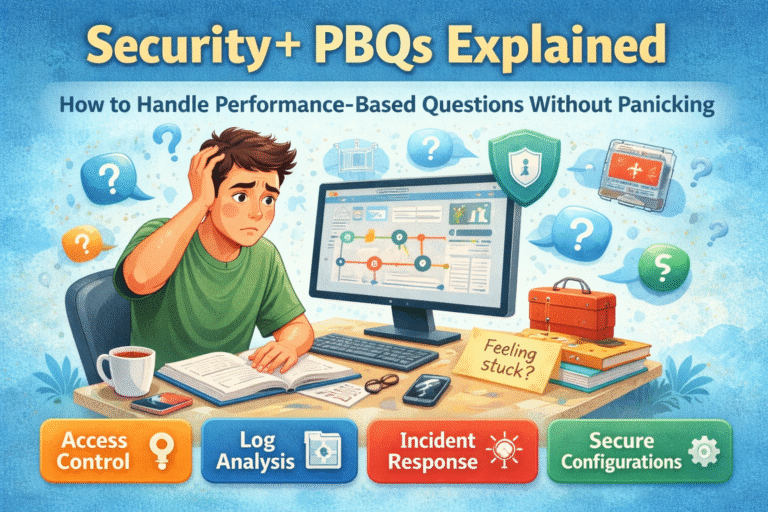
Security+ PBQs Explained: How to Handle Performance-Based Questions Without Panicking
If you are in the final stretch before your exam, there is a good chance Security+ PBQs are one of the things making you most nervous.
That is a very normal reaction. A lot of students feel somewhat steady with multiple-choice questions, then their confidence drops the moment they start thinking about performance-based questions. The format looks different, the screen can feel unfamiliar, and the pressure of exam week makes everything feel heavier than it needs to. For beginners, career changers, and working adults trying to balance study with real life, PBQs can start to feel like the most intimidating part of the whole CompTIA Security+ exam.
The good news is that they are usually not as impossible as they first seem.
Like the Network+ PBQ article in this same final-week style, this post is meant to help you focus on what actually matters when the exam is close. In this case, that means understanding what Security+ PBQs really are, why they create so much anxiety, and how to approach them with more calm and more logic.
What Are Security+ PBQs?
In simple terms, performance-based questions are questions that ask you to do something with what you know.
A traditional multiple-choice question might ask you to identify a concept, define a term, or choose the best answer from a list. A PBQ is different. It usually places you in a small security scenario and asks you to work through it in a more practical way.
That may mean interpreting a security alert, deciding which control fits a situation, reviewing a log, understanding how access should be configured, or making sense of a simple incident-response scenario. The point is not just to see whether you recognize a cybersecurity term. The point is to see whether you can apply security knowledge in a realistic setting.
Why Security+ Performance-Based Questions Feel So Intimidating
A lot of PBQ anxiety comes from the first impression.
You open the question and suddenly the screen looks different. There may be a firewall-style interface, a small network map, a log snippet, a list of settings, or a scenario that looks much more hands-on than a normal question. Before you have even read carefully, stress kicks in.
There is also the pressure of time. During the final week, students are already worried about weak areas, practice scores, and whether they are truly ready.
Some students also assume that if they do not immediately understand every label or setting on the screen, they are already stuck. That is usually not true.
Most PBQs are not asking whether you are flawless. They are asking whether you can read a security scenario carefully, notice what matters, and think your way toward a reasonable solution.
How to Approach Security+ PBQs Calmly
The first thing to remember is simple: do not let the screen scare you before you understand the task.
A PBQ can look busy without actually being as complicated as it seems. Sometimes there is a lot on the screen, but the task itself is fairly narrow. Students often make these questions feel worse by reacting to the appearance of the question before they really read it.
So start there.
Read the full prompt. Read the instructions. Read the labels. Read any notes or requirements included in the scenario. Make sure you understand what the question is actually asking before you start solving anything.
This matters because students sometimes lose points by trying to solve the wrong problem. They assume the task is broad when it is actually specific. They focus on one detail that catches their eye and miss what the question really wants.
When you slow down and read carefully, PBQs often feel much more manageable.
What Do PBQs Test on the Security+ Exam?
Students should never assume a specific question is guaranteed to appear, but they should be comfortable thinking through common hands-on security situations that fit the Security+ level.
That can include interpreting basic access control logic, understanding authentication and authorization scenarios, reviewing a simple log or alert, thinking through security controls, recognizing how a configuration affects risk, or walking through a small incident-response or vulnerability-related situation.
The goal is not to memorize imaginary screens. The goal is to become more comfortable reasoning through realistic security situations.
Common Security+ PBQ Skill Areas to Practice
During the final week, it helps to be comfortable thinking through a few practical security tasks.
One is access control and identity logic. You may need to reason through who should have access, what kind of authentication fits the situation, or how permissions should be applied.
Another is reading logs, alerts, or security indicators. Sometimes the challenge is not advanced at all. It is simply noticing what the evidence is pointing to.
Another is basic incident response thinking. You may need to identify the best next step, understand the purpose of containment, or recognize what kind of response makes sense in a given situation.
Students should also be comfortable thinking through secure configuration choices. That can include recognizing a weak setting, understanding what change reduces risk, or identifying which control best fits the scenario.
It also helps to practice network and host security reasoning. If a scenario shows suspicious behavior, failed access, an exposed service, or unusual traffic, you need to think through what that likely means.
And finally, students should be ready to interpret small security scenarios without overcomplicating them. In many cases, that is the heart of PBQ thinking.
Use Logic and Elimination Instead of Panic
One reason PBQs feel overwhelming is that students assume they must know the full answer immediately.
Usually, that is not how it works.
A lot of the time, you can make progress simply by using logic. If one user clearly should not have access, that tells you something. If a log entry points to repeated failed attempts, that tells you something. If a system is behaving in a way that suggests misconfiguration or exposure, that also gives you a clue.
Elimination helps too. Some options clearly do not solve the stated problem. Some settings obviously do not match the security goal. Some answers create more risk instead of less. Ruling those out can help guide you toward the best answer.
This is one reason PBQs often become less scary once students stop treating them like a trick and start treating them like a scenario that can be reasoned through.
What to Do If a Security+ PBQ Looks Confusing on Exam Day
If a PBQ initially looks confusing, pause and read the instructions again carefully.
Break the problem into smaller pieces. Identify the goal. Look at the clues provided. Determine whether the issue relates to access control, authentication, logging, configuration, incident response, or another area.
A confusing-looking PBQ often becomes much clearer once you stop trying to understand everything at once.
And if it still feels difficult, do not let one question throw off your mindset for the rest of the exam. One hard question is still one hard question. It is not the whole test, and it is not proof that you are unprepared.
A steady mind helps a lot more than panic does.
Are Security+ PBQs Harder Than Multiple Choice?
They can feel harder because the format is different and less familiar.
However, they are often testing practical thinking rather than trying to trick you.
Many students eventually find PBQs manageable once they stop treating them like some mysterious part of the exam and start treating them like small security problems that need to be read carefully and solved logically.
How to Practice Security+ PBQs During the Final Week
During the last week before the exam, it helps to move beyond passive reading and think through realistic scenarios.
If you are reviewing identity and access management, imagine what an access problem might look like in a workplace. If you are studying threats and vulnerabilities, think about what evidence would point to one issue rather than another. If you are reviewing operations and incident response, consider what the right next step would be in a small security event.
This type of scenario-based thinking helps bridge the gap between memorization and real-world security reasoning.
At ASM Educational Center, many students preparing for certifications are balancing work, family responsibilities, and study time. A calm and practical approach often helps far more than trying to memorize everything at once.
Do Not Let One Difficult PBQ Ruin Your Exam
If one question seems difficult, do not let it disrupt the rest of the exam.
Many students lose focus because they dwell on a single problem. Instead, stay calm, do what you reasonably can, and move forward.
A steady mindset can make a big difference on test day.
Conclusion: Security+ PBQs Become Easier Once You Understand Them
A lot of fear around Security+ PBQs comes from not knowing what to expect.
Once you realize that these questions are simply testing your ability to think through practical security scenarios, they become less intimidating. They may still look unfamiliar at first, but unfamiliar does not mean impossible.
Read carefully. Think logically. Eliminate what clearly does not fit. Stay calm. Do not expect perfection.
With the right mindset, PBQs can become one of the more manageable parts of the exam, especially once you stop viewing them as a threat and start viewing them as a problem to work through.
If you would like to explore this topic further, you can read more of our cloud and certification blogs or visit www.asmed.com for additional resources. If you are currently unemployed and live in the Washington, D.C. area, you may qualify for grant-funded IT training. Eligibility details are available at www.asmed.com/wd.
Cloud careers are built step by step. With the right foundation and steady growth, AWS certifications remain a practical and reliable place to begin.
PBQs, or performance-based questions, are questions that ask you to apply security knowledge in a practical scenario instead of only choosing an answer from a list. They may involve reading a log, reviewing access settings, thinking through a security control, or working through a small incident-related situation.
They often feel harder at first because the format is less familiar and more hands-on. But that does not always mean they are harder in substance. Many students find them more manageable once they slow down, read carefully, and treat the question like a real security problem instead of something designed to trick them.
The best final-week approach is to move beyond passive review. Work through scenario-based questions, talk through security logic step by step, and ask yourself how topics like access control, authentication, logging, risk reduction, and incident response would appear in a real environment. You are training yourself to think clearly under pressure, not just memorize definitions.
Pause first. Read the instructions again. Focus on the actual goal of the question before reacting to how the screen looks. Break the scenario into smaller parts and look for clues that tell you whether the issue relates to access control, logging, configuration, or another security area. Do not let the first few seconds of confusion turn into panic.
The exact questions can vary, and no one should expect guaranteed formats. But students should be ready to think through practical areas like identity and access logic, reading logs or alerts, secure configuration choices, basic incident response thinking, and small security scenarios that require calm reasoning.
