


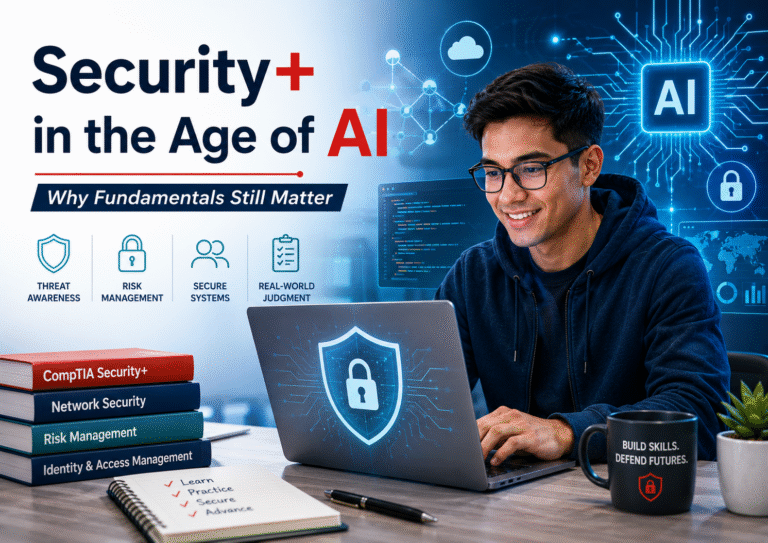
Is Security+ Training Still Valuable in the Age of AI?
Artificial intelligence is changing cybersecurity quickly. AI tools can summarize logs, assist with phishing analysis, generate reports, help review security alerts, and support teams that are already under pressure. Because of that, many beginners are asking a serious question: is Security+ still valuable in the age of AI?
The answer is yes.
Security+ training is still valuable because AI does not remove the need for cybersecurity fundamentals. In many ways, it makes those fundamentals more important. If a student does not understand threats, identity, networks, cloud security, incident response, risk, and security operations, they may struggle to understand what AI tools are actually doing. AI can produce an answer, but cybersecurity professionals still need to know whether that answer makes sense.
For beginners, Security+ remains one of the strongest starting points because it teaches the foundation behind modern cyber defense. AI may change the tools people use, but it does not replace the need for trained judgment.
AI Is Changing Cybersecurity, But It Is Not Replacing the Basics
AI is already being used in cybersecurity work. Security teams may use AI-supported tools to detect unusual activity, summarize large amounts of data, assist with investigations, or speed up repetitive tasks. This can help organizations respond faster, especially when teams are dealing with more alerts than they can manually review.
But faster tools do not automatically create better security decisions.
A tool may flag suspicious login activity, but someone still needs to understand why that activity matters. Was it a stolen password? Was it MFA fatigue? Was it impossible travel? Was it privilege escalation? Was it a misconfigured account? Was the alert connected to a larger attack?
AI can help organize the information, but the person reviewing the situation still needs cybersecurity knowledge. Without that foundation, a beginner may accept an AI-generated answer without knowing whether it is accurate, incomplete, or risky.
That is why Security+ still matters. It gives students the language, structure, and logic needed to understand cybersecurity problems before they rely on tools to help solve them.
Why Security+ Still Matters for Beginners
Security+ is valuable because it introduces students to the core areas that cybersecurity work depends on. It is not only about memorizing attack names or learning definitions. A strong Security+ foundation helps beginners understand how different parts of cybersecurity connect.
Security+ covers topics such as threats, vulnerabilities, security architecture, identity and access management, security operations, risk management, incident response, governance, and compliance. These are still necessary in the age of AI because AI tools do not remove the need to understand what is being protected, how attacks happen, and what proper defense looks like.
For example, a student studying Security+ learns why least privilege matters. That concept is still important when AI tools are involved because AI systems may interact with sensitive data, permissions, cloud resources, and user accounts. A student learns why logs matter. That is still important because AI-generated summaries are only useful if the student understands what the logs mean. A student learns about phishing, ransomware, malware, and social engineering. Those threats have not disappeared. In many cases, AI is making them faster and more convincing.
Security+ gives beginners the foundation needed to understand modern cyber risks instead of treating security tools like black boxes.
AI Makes Hands-On Understanding More Important
One of the biggest mistakes students can make is thinking they only need to memorize exam terms. That approach was already weak before AI. Now it is even weaker.
In the age of AI, students need to understand how cybersecurity concepts work in real scenarios. It is not enough to know what phishing is. Students should understand how phishing can lead to credential theft, why MFA helps, how MFA can still be attacked, what logs may show suspicious activity, and how an organization should respond.
It is not enough to define encryption. Students should understand why encryption protects data, where it is used, and what risks remain if access control is weak.
It is not enough to know what a SIEM is. Students should understand why security teams collect logs, how alerts are reviewed, and why context matters during an investigation.
This is where hands-on Security+ training becomes important. Students need practice connecting the exam objectives to workplace situations. They need to hear examples, ask questions, work through scenarios, and build the habit of thinking through risk.
AI can assist with cybersecurity tasks, but hands-on learning helps students understand what those tasks actually mean.
Security+ Helps Students Understand the “Why” Behind Security Tools
Cybersecurity tools are useful, but tools are not enough by themselves. A beginner who only knows how to click through a dashboard may not understand the risk behind the alert.
Security+ helps students understand the “why.”
Why does access control matter? Why should accounts use least privilege? Why should organizations monitor logs? Why are backups part of security? Why does network segmentation reduce risk? Why do incident response steps matter? Why is user training still necessary? Why do organizations need both prevention and detection?
These questions matter because cybersecurity is not only about identifying threats. It is about making decisions that reduce risk.
AI tools can help surface information, but students still need the foundation to interpret that information. Security+ gives beginners a structured way to build that foundation.
AI May Raise the Bar, But It Does Not Close the Door
Some beginners worry that AI will make entry-level cybersecurity impossible to enter. That fear is understandable, but it needs to be handled carefully.
AI may change some entry-level tasks. It may automate certain repetitive duties, help analysts move faster, and change what employers expect from new candidates. But that does not mean beginners are no longer needed. It means beginners need to be better prepared.
The students who struggle will often be the ones who only memorize definitions and expect the certification alone to do the work for them. The students who stand out will be the ones who understand the concepts, practice applying them, and can explain how security ideas connect to real problems.
Security+ is not a magic shortcut into cybersecurity. But it is still one of the best starting points because it helps students build the foundation that later skills depend on.
Before someone can specialize in cloud security, SOC analysis, threat hunting, governance, risk, compliance, penetration testing, or AI security, they need to understand basic cybersecurity principles. Security+ helps organize that learning path.
Why Security+ Training Still Matters at ASM Educational Center
For many students, Security+ can feel overwhelming because it covers a wide range of topics. Threats, vulnerabilities, cryptography, identity, access control, architecture, cloud security, risk, compliance, and incident response can feel like a lot to learn at once.
That is why structured training matters.
At ASM Educational Center, Security+ training helps students prepare with instructor guidance, study support, and explanations that connect exam topics to real-world cybersecurity situations. The goal is not just to recognize terms on a test. The goal is to understand how the concepts work together.
This matters even more in the age of AI. As cybersecurity tools become more advanced, students need stronger fundamentals, not weaker ones. A student who understands Security+ concepts is better prepared to evaluate what tools are doing, ask better questions, and continue growing into more advanced areas of cybersecurity.
AI may help security teams move faster, but students still need a foundation that helps them think clearly.
Security+ Is Still Valuable, But Preparation Matters
Security+ is still valuable in the age of AI because cybersecurity still depends on people who understand risk, threats, identity, networks, cloud environments, incident response, and security operations. AI can support cybersecurity work, but it does not replace the need for trained judgment.
For beginners, the better question is not whether AI makes Security+ irrelevant. The better question is whether students are preparing for Security+ in a way that builds real understanding.
Students who only memorize terms may struggle. Students who focus on hands-on understanding, practical examples, and strong fundamentals will be better prepared for both the exam and the changing cybersecurity field.
AI is changing cybersecurity, but it has not changed the need for a strong foundation. For many beginners, Security+ remains one of the best places to start.
Final Thoughts
Technology will continue to change, and cybersecurity will continue to change with it. AI will become a larger part of security tools, business operations, and cyber threats. But very new tool still depends on people who understand the basics well enough to use it responsibly.
Security+ training gives beginners a practical foundation in the concepts that modern cybersecurity still relies on. It helps students understand the language of security, the logic behind defense, and the risks organizations face every day.
In the age of AI, that foundation matters more than ever.
Yes. Security+ is still worth it because AI does not replace the need to understand cybersecurity fundamentals. Students still need to know how threats, identity, networks, cloud security, incident response, and risk management work.
AI may change some entry-level tasks, especially repetitive work, but it does not remove the need for people who understand security concepts and can make informed decisions. Beginners may need stronger hands-on skills and better practical understanding.
AI tools can help analyze alerts, but people still need to understand what the alerts mean. Security+ helps students build the foundation needed to evaluate risk, interpret security events, and understand proper response steps.
Yes. Security+ is one of the most common starting points for cybersecurity beginners because it introduces core concepts across threats, vulnerabilities, security operations, identity, architecture, risk, and incident response.
Students should focus on more than memorization. They should study the exam objectives, practice scenarios, understand real-world examples, review performance-based questions, and connect security concepts to workplace situations.
If you would like to explore this topic further, you can read more of our cloud and certification blogs or visit www.asmed.com for additional resources. If you are currently unemployed and live in the Washington, D.C. area, you may qualify for grant-funded IT training. Eligibility details are available at www.asmed.com/wd.
Cloud careers are built step by step. With the right foundation and steady growth, AWS certifications remain a practical and reliable place to begin.
