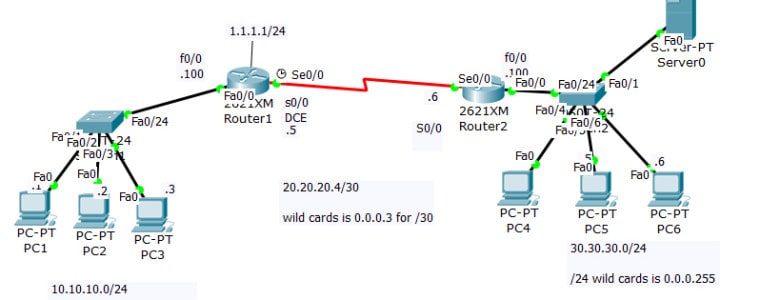
——Now I will do a LAB—-Goal is that the sales LAN =10.10.10.0/24 will not be able to access the
EGR LAN= 30.30.30.0/24
Pre step 1) what kind Of ACL?
Standard ACL- since It talk about the source if it says I do not want SALES Lan cannot access the webserver=30.30.30.200 (port 80)
that will be extended ACL …why >? Since I am talking about both source and destination
————-Step 1) I go to R1 and Write my ACL —-R1#
R1#config t
Enter configuration commands, one per line. End with CNTL/Z.
R1(config)#acc
R1(config)#access-list ?
<1-99> IP standard access list
<100-199> IP extended access list
R1(config)#access-list 3 ?
deny Specify packets to reject
permit Specify packets to forward
remark Access list entry comment
R1(config)#access-list 3 den
R1(config)#access-list 3 deny ?
A.B.C.D Address to match
any Any source host
host A single host address
R1(config)#access-list 3 deny 10.10.10.0 ?
A.B.C.D Wildcard bits
<cr>
R1(config)#access-list 3 deny 10.10.10.0 0.0.0.255
———–HINT: make sure you will have a permit statement at end of it why? Since there is an implicit deny at the end of ACL;
R1(config)#acc
R1(config)#access-list ?
<1-99> IP standard access list
<100-199> IP extended access list
R1(config)#access-list 3 ?
deny Specify packets to reject
permit Specify packets to forward
remark Access list entry comment
R1(config)#access-list 3 per
R1(config)#access-list 3 permit ?
A.B.C.D Address to match
any Any source host
host A single host address
R1(config)#access-list 3 permit any ?
<cr>
R1(config)#access-list 3 permit any
R1(config)#
——-Let’s look at show run —–
access-list 3 deny 10.10.10.0 0.0.0.255
access-list 3 permit any
———-NOW step 2) is to apply it to int s0/0
R1#config t
Enter configuration commands, one per line. End with CNTL/Z.
R1(config)#int s0/0
R1(config-if)#ip acc
R1(config-if)#ip access-group ?
<1-199> IP access list (standard or extended)
WORD Access-list name
R1(config-if)#ip access-group 3 ?
in inbound packets
out outbound packets
R1(config-if)#ip access-group 3 out ?
<cr>
R1(config-if)#ip access-group 3 out
R1(config-if)#
——–Here is my show run so far—
R1#show run
!
interface Serial0/0
ip address 20.20.20.9 255.255.255.252
ip access-group 3 out
clock rate 64000
access-list 3 deny 10.10.10.0 0.0.0.255
access-list 3 permit any
——-As we see I cannot ping the other Lan—
PC>ping 30.30.30.4
Pinging 30.30.30.4 with 32 bytes of data:
Reply from 10.10.10.100: Destination host unreachable.
Reply from 10.10.10.100: Destination host unreachable.
Reply from 10.10.10.100: Destination host unreachable.
Reply from 10.10.10.100: Destination host unreachable.
Ping statistics for 30.30.30.4:
Packets: Sent = 4, Received = 0, Lost = 4 (100% loss)
———————————————
Here I ping and I see it did not work and I see the result—
R1#show access-lists
Standard IP access list 3
deny 10.10.10.0 0.0.0.255 (4 match(es))
permit any
R1#show access-lists
Standard IP access list 3
deny 10.10.10.0 0.0.0.255 (8 match(es))
permit any